

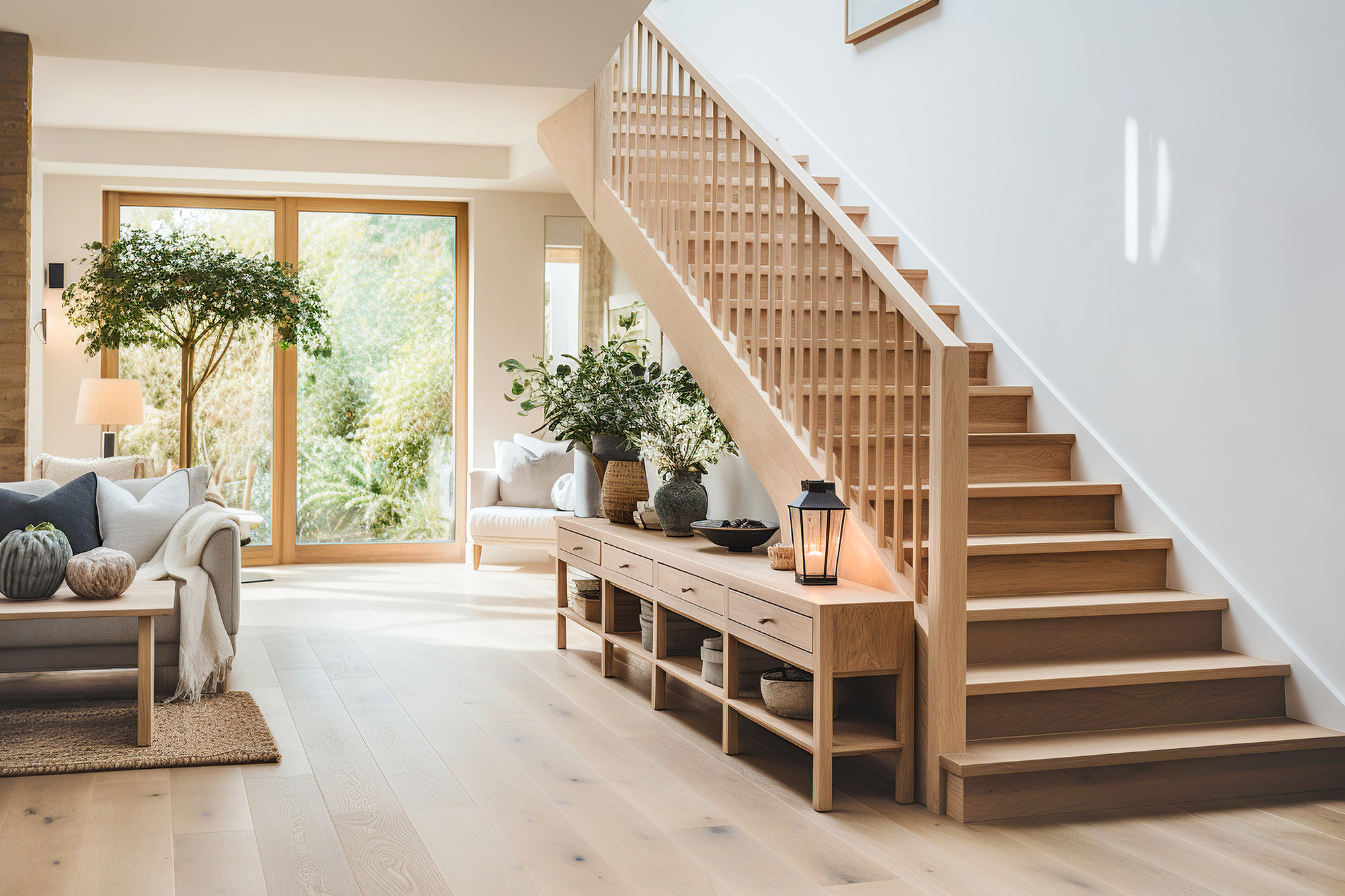
In a Lake Arrowhead home, the staircase is rarely just a way to get from one floor to another. Because mountain houses are often built vertically to work with steep lots, changes in elevation can become an important part of the home's architecture. A staircase may connect the main living area to bedrooms, a lower-level recreation room, or a loft overlooking the great room.
That makes the flooring on the stairs more important than many homeowners realize.
When the staircase flooring looks disconnected from the floors surrounding it, the transition can feel abrupt. When the materials, colors, textures, and proportions work together, the staircase can become one of the most visually impressive elements in the home.
For Lake Arrowhead homeowners considering a renovation, hardwood flooring offers an opportunity to turn the staircase into a natural extension of the home's design rather than treating it as a separate construction detail.
Why Staircases Matter So Much in Mountain Homes
Many Lake Arrowhead homes have multiple levels, lofts, split-level layouts, or lower floors that follow the natural slope of the property. That means the staircase is often visible from several areas of the home.
You may see it from the entryway, living room, kitchen, hallway, or even from a second-floor landing.
Because of this visibility, a staircase can influence how connected the entire interior feels.
A hardwood staircase can visually carry the same material language from one level to another. Instead of the main floor ending at the stair opening, the wood continues upward and creates a stronger architectural relationship between the spaces.
Think Beyond Matching the Floor Exactly
One common approach is to try to make the staircase perfectly match the surrounding hardwood floor. That can work, but it is not the only option.
A staircase can coordinate with the flooring without being an exact duplicate.
For example, a natural oak floor could be paired with stair treads in a closely related tone while using a slightly different finish or grain character. A darker stair tread can also create a deliberate architectural accent against lighter flooring.
The important thing is to make the relationship look intentional.
In a mountain home, that can be particularly effective because natural materials already tend to work well alongside exposed beams, stone fireplaces, wood ceilings, large windows, and other architectural features.
Wide-Plank Hardwood Can Influence the Entire Design
Wide-plank hardwood has become increasingly popular in interiors that emphasize natural materials and a more relaxed sense of luxury.
On a large main floor, wider boards can create a calmer visual rhythm. The same design philosophy can be carried into the staircase through substantial stair treads and carefully coordinated transitions.
The goal is not to make the stairs look oversized. It is to make them feel like part of the same architectural language as the floor.
This approach works particularly well in Lake Arrowhead homes with vaulted ceilings and open living spaces, where small flooring details can become visible from a considerable distance.
Natural Wood Works With the Mountain Setting
Lake Arrowhead homes have a natural advantage when it comes to hardwood design.
The surrounding landscape already provides a palette of deep greens, warm browns, gray stone, weathered wood, and changing seasonal colors. Flooring does not need to compete with that environment.
Natural-looking hardwood can act as the interior bridge between the architecture and the landscape outside.
Instead of relying on highly artificial colors or heavily distressed finishes, homeowners can choose wood with visible grain, subtle variation, and a finish that allows the material itself to remain the focus.
What About Dark Hardwood on Stairs?
Darker stair treads can create a dramatic look, especially when paired with lighter walls and flooring.
However, homeowners should think about the entire staircase rather than judging a single sample.
Dark colors can emphasize dust, scratches, and surface marks. In a home with pets, children, frequent guests, or outdoor activity, that may influence how practical the finish feels over time.
A medium natural tone can sometimes provide the visual depth homeowners want while being more forgiving of everyday activity.
Matte Finishes Fit the Modern Mountain Home
High-gloss floors can create a formal appearance, but today's interiors are increasingly moving toward matte and low-sheen finishes that emphasize the natural appearance of wood.
That approach can be particularly attractive in a Lake Arrowhead setting.
A low-sheen finish allows the grain to provide much of the visual interest rather than relying on reflection. It also complements other natural surfaces such as stone, leather, wool, timber, and textured fabrics.
The result is a staircase that feels refined without looking overly polished.
Do Not Forget the Landing
The stair treads may receive most of the attention, but the landing is just as important.
If hardwood is being installed or replaced throughout multiple levels, the landing can become the point where different rooms visually connect.
Think about the flooring as one continuous journey: entry, living room, staircase, upper hallway, and bedroom or loft.
Each transition should feel considered.
Hardwood and Stair Runners Can Work Together
Some homeowners hesitate to use hardwood on stairs because they want additional softness, traction, or sound control.
A stair runner can provide another layer without hiding the hardwood completely.
The combination of exposed wood at the sides with a carefully selected runner through the center can create a finished, tailored appearance. The runner can also introduce color or pattern without requiring a permanent change to the entire staircase.
This can be especially useful when the home's overall style is somewhere between rustic mountain character and contemporary design.
Engineered Hardwood May Be Worth Considering
Hardwood does not necessarily mean solid hardwood in every part of a renovation.
Engineered hardwood uses a real wood surface over a layered construction and can be an option for certain installations where dimensional stability is an important consideration.
The appropriate product depends on the specific application, subfloor, installation method, and manufacturer's requirements.
For a whole-home renovation, it is worth discussing the construction of the flooring rather than selecting solely on appearance.
The Staircase Should Match the Personality of the Home
A traditional cabin does not need to have the same staircase as a contemporary Lake Arrowhead retreat.
For a rustic interior, stronger grain variation and warmer tones may feel natural.
For a modern mountain home, a cleaner grain, wider boards, and a matte finish may create the right balance.
For a transitional home, natural hardwood can bridge traditional furniture with newer architectural elements.
The best staircase is one that looks as though it belongs to the house.
Flooring Should Be Planned From the Top of the Stairs Down
When planning a flooring renovation, do not select the main floor first and figure out the stairs afterward.
Consider the staircase at the beginning of the process.
Look at the flooring sample alongside the stair design, railing, wall color, trim, fireplace materials, and cabinetry.
This helps prevent a common renovation problem: choosing a beautiful floor that becomes difficult to coordinate once the vertical surfaces enter the picture.
Make the Staircase Part of the Architecture
In a Lake Arrowhead home, the staircase can become far more than a functional element.
It can frame the living room, reinforce the use of natural materials, connect multiple levels, and give the interior a stronger sense of continuity.
If you are considering hardwood for a staircase, landing, or broader renovation, explore hardwood flooring from Arrowhead Floor & Windows to begin comparing styles, colors, and finishes.
When you are ready to discuss your project, contact Arrowhead Floor & Windows to explore flooring options for your Lake Arrowhead home.
The most successful mountain-home renovations do not make every room look identical. They create relationships between spaces. When hardwood travels naturally from the floor to the staircase and onto the next level, that relationship can make the entire home feel more considered, cohesive, and connected to its setting.


